The findings from the I‑ASC study show that recommending communication aids is a complex and highly individual process.
This UK-evidence based investigation revealed that competing yet interconnected elements, such as the characteristics of the child, access features, and aid attributes, all require consideration when identifying the most appropriate aid for each child. The I-ASC evidence also suggests that these decisions are influenced by cultural work practices, the contexts of service provision and the communication environments surrounding the child.
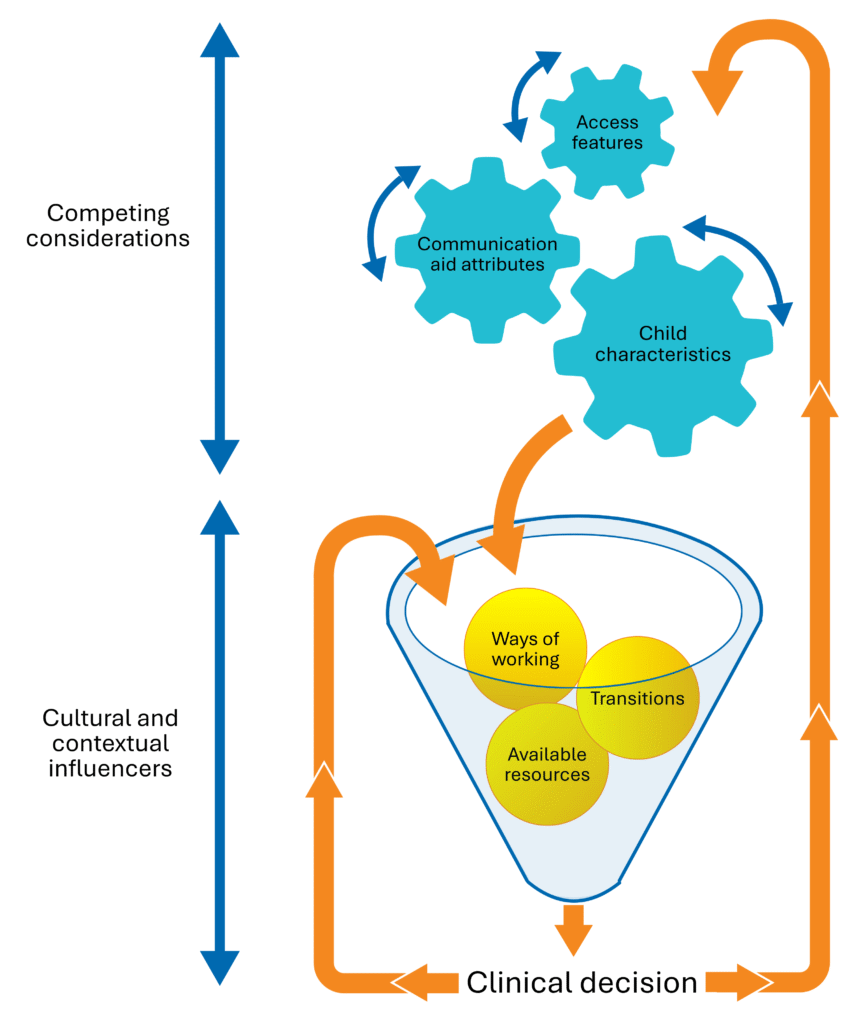
To visualise this complex and dynamic interplay of competing considerations and influencers, an I-ASC explanatory model of things to consider when making symbol communication aid recommendations for children was developed from the research findings (shown below).
The I-ASC Explanatory Model of AAC decision making
Learn more about the design and layout of the I-ASC explanatory model by click on the “I-ASC Model Explained” tab at the top of the screen.
Since the original release of this research and website, we have had considerable feedback that although originally developed with a focus on children and young people, with a little modification of the content provided, there is relevance to individuals across their lifespan. We encourage you to consider minor adaptations to better suit your context.
The design and layout of the I-ASC model is explained briefly in the drop-down sections below:
The I-ASC Explanatory Model of AAC decision makingCompeting Considerations (the cogs)
The top half of the model shows us three interlinked cogwheels representing the competing considerations of child characteristics, communication aid attributes and access features. As options are debated in one cog, they can cause a shift and movement in the other cogs. This can change the relevance of the preferred aid recommendation option. The cogwheel motion represents the fluidity of decision making and the competing constraints resulting in identification of the best-fit options, rather than always the most preferred options.
Child characteristics form the biggest cog because each child brings a unique set of characteristics. Children and young people who benefit from AAC systems come with a diverse yet individual range of abilities and challenges that include aspects of their sensory, cognitive, language, learning and physical traits. The I-ASC child characteristics list provides the elements that emerged across the different aspects of the research.
Communication Aid Attributes form the second cog. This cog describes a set of attributes within existing technology, specifically hardware, components of software and organisational qualities of vocabulary packages.
Access features form the third cog. This cog represents the importance given to access features in the I-ASC data and the level of consideration given to these features in the clinical decision making process. It is also separate as it represents the interaction between child and communication aid and the considerations needed to make the interaction work as effectively as possible. The I-ASC access features list was generated during the research.
Competing Considerations Explained
Cultural and Contextual Influencers (the bubbles)
The bottom half of the model illustrates the cultural and contextual elements that were found to inform final communication aid recommendations. These are summarised as ways of working, available resources and transitions. These elements are visually represented in the bubbles bouncing around before a decision is funnelled through to a recommendation.
Collectively they detail the elements that may be external to the child or young person, family member or professionals involved. This includes things like service structures, policies, available staffing and anticipated changes of context for the young person. The descriptions provided were generated as topics for consideration during the research.
Cultural and Contextual Influencers Explained
The Arrows
The orange arrows highlight the interaction between the top and bottom half of the model. Competing considerations and cultural and contextual influencers do not operate in isolation. Each interacts with the other and affecting the final AAC recommendation.
Learn more about how to use the I-ASC explanatory model to support your communication aid decision making process by clicking the “Using the model” tab at the top of the screen.
Since the original release of this research and website, we have had considerable feedback that although originally developed with a focus on children and young people, with a little modification of the content provided, there is relevance to individuals across their lifespan. We encourage you to consider minor adaptations to better suit your context.
How to use the I-ASC explanatory model in your decision making
We encourage you to consider the detail of the I-ASC explanatory model to support your AAC decision making. The I-ASC Model can help you to review each component individually, as well as how they may interact when working towards a shared communication aid recommendation.
The different parts of the model (‘cogs’ and ‘bubbles’) are presented in further detail on their own pages, which you can access using the buttons below. Each page offers specific things for you to think about when considering that element. These are not presented in any order of priority, as prioritises will vary for each child being considered for a symbol communication aid recommendation.
You are not expected to work through every element of the model. Identify which elements seem most relevant to your child or young person and start reading the detail provided under those headings. Later you may choose to look at other aspects of the model.
Tools and Materials to support AAC decision making
A collection of ASC for AAC tools and materials has been developed to support your AAC decision making. These resources may help with your problem solving and decision deliberations as you apply the I-ASC explanatory model.
Since the original release of this research and website, we have had considerable feedback that although originally developed with a focus on children and young people, with a little modification of the content provided, there is relevance to individuals across their lifespan. We encourage you to consider minor adaptations to better suit your context.
ASC for AAC . Communication aid assessment . AAC assessment . ASC for AAC . ASC for AAC . ASC for AAC . ASC for AAC . ASC for AAC . ASC for AAC . ASC for AAC .